Showing posts with label CRPG. Show all posts

Sunday, January 29, 2012

Making Maps Better: Part 1

I don't know about anyone else, but a favorite part of playing these old CRPGs is map making. A stack of handy graph paper sits on my table that would probably last me a good 30 - 40 games if I used both sides. However, with the number of games I have on this list, I'm exploring a more digital solution.

There's nothing quite like a clean graph paper map.
My hope is to reproduce maps like the above using a handy tool. I'm making one of my own, and I'll post it for everyone else once I've been able to solidify a design and make it presentable enough for others to use. Before that happens, it needs to have more features than it currently has such as saving maps, naming them, loading them, exporting them as a bmp or png, etc. I have a lot of ideas for the app, but since this is my first time programming in ActionScript 3 (or any Flash based programming), it'll take some time to get familiar with the language and its capabilities before I have something up.

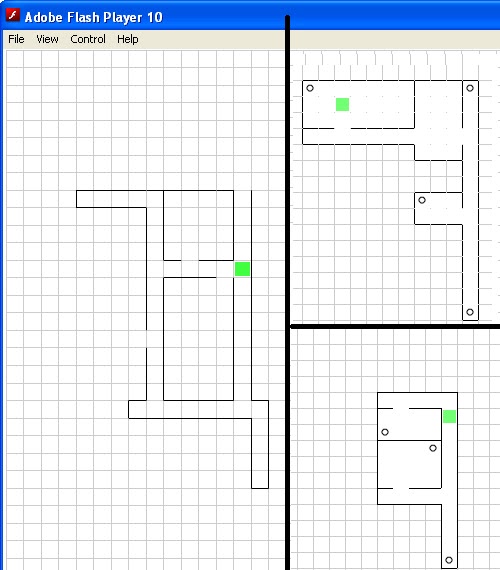
Honestly, I was hoping to have something up this weekend, but I overestimated how different AS3 is from my previous programming. Right now I have something workable for myself, but hardly anything to be proud of or useful to anyone else. It only supports one map at a time at a fixed 30 x 30 without any resizing, moving, or expanding of the map. As an end goal for this, I'm hoping to make something useable as a tool to create an archive that others can submit maps to for storage, load to edit, and submit revisions. I really don't know how to do all that, but it's nice to dream. First step in any case, complete this phase and get something up so that others can take a look, play with it, and find what's missing.

Left: original version; Upper: current version; Lower: alternative version
For those interested: the idea here is to create a program using the arrow keys for adding walls, doors, pathways, and markers. Currently, moving the cursor is done with arrow keys, walls are added by holding Ctrl and pressing a direction, doors (not implemented yet) are similar, pathways currently are like walls except holing Ctrl + Shift, and markers are placed with Enter (erased with space bar). This is mostly a prototype to get an idea for what it'd look like, there's still a long way to go to reach a stable program, but I see hope for it. Eventually, markers will have descriptions and unique icons, walls will have doors and special types, and the map itself will have coordinates and transform options.

Thinking on it, this application doesn't need to be limited to grid based maps; it could incorporate tile graphics, and rooms for adventure games. They're all pretty similar when you break down a room or square into a list of walls and exits. I'm setting a goal of the end of next month to have a working alpha that a few here can take a stab at if anyone is interested.

Please do let me know if I'm reinventing the wheel though. I couldn't find anything like this in any of my searching all week for a simple tool that has these features, so I've started this. Thoughts, and suggestions now before I waste anymore time on this are always welcome.

Tuesday, January 24, 2012

Rules and Ratings

First let's get through the rules. These are here to keep me honest, and inform you the readers what limitations I've placed on myself. Much of this is based on CRPG Addict's rules; I owe him for his example.

1) Console games: I've always considered myself a console gamer. I don't exclude PC games outright in my playing decisions, but as a kid whose dad took up the computer most of the time, I learned to get by with console games. Stability is the number one reason I enjoy consoles now; crashes aggravate me to no end. Also, the CRPG Addict has PC games covered.

2) CRPG inclusion: I have a list. It can be added to, but nothing is taken off it. I'll mark games on the list: yes it is or no it is not a CRPG. I'll post per release year discussing those games that don't meet my requirements. I may play a game if there's a strong call from the comments to include it.

3) US released games: I'm in the US, so it's just easier this way. There are many Japanese or European exclusive games that interest me, and I may play through some, but all NTSC-U is the goal here. The games are in chronological order based on original US release.

4) Official releases ideal: No emulators; however, allowances made for Wii Virtual Console, re-releases on other consoles, etc. Emulation is unstable for later games, and the roms are illegal currently. This means I may not have the next game, but I'll revisit those I've skipped as soon as I can. Any help to get games is appreciated. While this is all still true, and the preferred method is playing the original, I've altered my stance. If there's no current way to purchase a game that benefits the rights holder, then I'll make allowances for emulating the game in order to keep things moving. If ever a game becomes available to purchase legitimately, please let me know as I do believe in rewarding the creators of these works. I don't see how paying anyone else benefits the creation of these games. Emulated titles are denoted with a asterisk (*).

5) No cheating: No cheat codes, walkthroughs, or player-made maps. The only documentation that I'll allow myself is what originally came with the game or a port. I'd like to keep hints from readers and viewers kept to a minimum; use your best judgment on that. After I finish, I'll read a walkthrough or two to make sure I cover everything in the review.

6) Roll credits: I will play each game to the very end. Looking at the CRPG Addict's efforts, I wonder how sane this is, but I'm convinced it's the way to go. I want to give the game every chance to redeem itself. This also means the game needs to end or show an ending sequence. And, to be honest, we all know console games are easier, right? ;)

7) Minimal saving/loading: I'm not going to save at every other step nor after every risky encounter. Once per save point, per level, per dungeon, or in town only: whatever makes sense for the current game. I'll only reload a game if I get a game over.

Rating System
If you read the last post, then you can probably guess the categories of my rating system. I took the persona types and described them by a title. Taking a[nother] page from the CRPG Addict and the Adventure Gamer, I've come up with my own acronym to accompany my rating system. Here's a quick rundown of CAPICE:

Combatant - Stomping bad guys and overcoming the odds:
 - Balanced combat that remains challenging.
 - Interesting options and strategies during combat.
 - Enemies are unique, interesting, and fit well with the game world.
 - Fighting is heavily influenced by stats rather than a player's dexterity.
 - Satisfying and balanced rewards for defeating encounters.

Admirer - It's all about the 'my guys':
 - Abilities advance based on practiced or repeated actions.
 - Skills and magic are customizable.
 - Appearance is adjustable and changes based on items equipped.
 - Advancement options are available with equally viable options.
 - Control of the characters is intuitive, smooth, and satisfying.

Puzzler - For those less inclined to combat, these are the other obstacles to overcome:
 - Main quest or the next goal is clearly defined.
 - Side quests are available and interesting.
 - Puzzles and mini-games are challenging without being frustrating.
 - All the above mesh with the setting and the rewards are fitting.
 - Multiple solutions exist and lead to different outcomes.

Instigator - What would a CRPG be without a story to drive it?
 - Main narrative draws the player into the world as an active participant.
 - NPCs offer dialogue options and help with quests and puzzles.
 - Descriptions are provided for locations, items, enemies, NPCs, and characters.
 - Immersion is enhanced by all story elements.
 - Player decisions influence the story and the consequences are obvious.

Collector - Get stuff, sell stuff, get better stuff:
 - A variety of items exists in the game world to find.
 - Game world economy exists, and does not become irrelevant.
 - If party inventory is limited, a place exists to store equipment and items.
 - Relative strength and value of items is available in the game.
 - Achievements are tracked, and completion is obvious.

Explorer - A whole new world to find:
 - Graphics, music, and sound effects are not distracting from enjoyment.
 - World and environments are interesting, rewarding discovery.
 - Atmosphere is inviting and consistent.
 - Points of interest, unique features, and Easter eggs exist; they fit in the game world.
 - Exploration is open, and characters are not arbitrarily (invisible walls) cut off from places.

Each category has a max of 10 with 100% max total score being a perfect 60. Much like CRPG Addict, I'll be grading each game based on my enjoyment at the time I play it; historical significance is not reflected in this rating.

I think that about covers all the logistics. I appreciate comments on any area.

Sorry for the all text post, but I wanted to get these two topics out of the way now. In case you skipped over all the above (or your eyes just glazed over until this last bit), don't worry, relax, and enjoy the ride. On to the games!

Sunday, January 22, 2012

Determining a CRPG

I'm new to blogging, and reading blogs. No research, no deep thought on blogs, no clear path for this project, it's no wonder why I never gained any followers and quickly lost interest last year. I recently had the urge to start this up again, this time with a plan. While researching RPGs, I discovered the CRPG Addict's blog, and it opened my eyes to what blogs could achieve. If you haven't read it, I strongly suggest you do; I can't speak highly enough about it (although he's on indefinite hiatus at the moment). From his example I believe I need a list of games, a way to determine if a game is a CRPG, rules to follow, a rating system, and great writing skills. I'm hoping the last will improve over the course of this project.

I have a list of US released CRPGs compiled from Wikipedia, MobyGames, and RPGamer. Looking it over I discovered something. There is a lot of confusion about what a CRPG is and how to define one. A simple definition eludes me along with every other site I've looked to, most requiring a list of attritbutes a CRPG could contain. If a majority of those qualities exists, then we can call it a CRPG. Everyone expects and takes something different from the genre, so there will never be a simple definition. Some will like the story, while others enjoy the combat, the treasure, the exploration, or the characters to varying degrees.
With all the talk of computer RPGs, I feel like I'm missing out sticking to console games.
The first book I came across that discussed CRPGs in detail was Swords & Circuitry. It discusses a group of personalities it terms 'the usual suspects': Fragmaster, Problem Solver, Treasure Hound, Story Chaser, Navel Gazer, and Tourist. These types largely influenced my rating system (next post I swear). The author(s) suggest that these six personalities encompass different aspects that players of CRPGs seek out in these games. So, I'll use these same persona's as a starting place to define CRPGs.

Based on the roles above and CRPG Addict's definition, GIMLET (his rating system), and evaluation method here's my list of characteristics that make up a CRPG in order of importance:

1) Character advancement based on repeated (practiced) action. This is accomplished most often through experience points or stat increases based on use. This is to separate stat and level increase solely based on the collection of items.

2) Combat based on character stats. The other end of the spectrum is combat based completely on equipment and player skill. Relatedly, turn-based combat will outweigh real-time combat.

3) Exploring an open environment. By open I mean previous areas aren't cut off by arbitrary invisible barriers. Also, if the game allows open exploration forward that's even better.

4) Engaging narrative and NPCs. A fleshed out world with interactive elements and activities aside from the main quest all contribute to this. In opposition to this is a story that only exists in the beginning and end of the game.

5) Spoils of war. Weapons, armor, potions, random useless trinkets, trophies, and anything else discovered from treasure chests, quests, or loot from fallen enemies. The more the better, and places to store it if character/party inventory is limited.

6) Quests, riddles, and puzzles. In addition to a main quest, side quests exist to enhance immersion in the game world. Obstacles and challenges exist outside combat, and use the game world as a reference instead of the real world.

There are of course other aspects that enhance the experience, but this list should allow me to focus on games the majority would not dispute as a CRPG. This is in order of importance, so if a game is missing #1 it'll be hard pressed to make my play list. The weight of each can vary, but an approximation for max score is 4, 3, 3, 2, 2, 2 respectively. At a guess, I'd say a score of 10 should mean it's a CRPG. We'll see how this holds up over the first few games.
OK, ready to judge!
I'm only going to add to the game list, never remove anything, marking what I consider not a CRPG. Consistency is the goal here, and I hope it will encourage people to defend a favorite CRPG that I've dismissed. If enough convincing arguments are made, I'll play through the game and give a more detailed review. So, if you can't find a game, please suggest it as I've obviously missed it; especially if it's an older game.

Later this week I'll make a post to address the few I've already ruled out, including Deadly Towers (released before Phantasy Star). These posts will cover yearly groups of games.

Other Resources:
Armchair Arcade
Wikipedia

Friday, January 20, 2012

CRPG Beginnings

For those that find history interesting and those not familiar with the difference between computer and console RPGs, here's my understanding of CRPGs. Feel free to skip this if you're not into it and come back next post.

There are computer RPGs and console RPGs. One may wonder, why the distinction though? A console is just a factory made computer after all. But, the distinction (sometimes made as Western RPGs and Japanese RPGs respectively) stems from what drives these two types of games.

CRPG or CRPG, not confusing at all, eh?

It all started with pen & paper role-playing games, which got their start from table top war games. RPGs have a history of openness, exploration, and discovery. Choose to play the way you want to, this is the offering of pen and paper RPGs. Early CRPGs did the best they could to mimic this experience by presenting scenarios similar to D&D. Many emphasized exploration and discovery, minimizing choice and openness to fit the programmable nature of computers. Calculations and statistics are a computer's bread and butter, so it's understandable that early CRPGs would expose and highlight these as a driving force behind the initial offerings while focusing on a singular storyline.


Wizardry in all its 8-bit glory.

During this time American game consoles were being flooded with games, bad games. There was no control over what games could be made and released for the systems, and this led to a crash in the console market here; however, the Japanese home video game market was thriving during this same time. America was introduced to the Nintendo Entertainment System shortly before all hope is lost to console video games.


See robot? Gun? It is a toy...

Marketed as a toy or "entertainment system" the NES avoided the moniker of home video game console, which had a poor reputation currently in America. Soon after, the last remaining American video game consoles slowly gave way to the quality games released for the NES. Seeing the opportunity to compete with Nintendo in a new market, Sega released their Mark III dubbing it the Sega Master System. So, the console market becomes driven forward by Japanese companies, and this remains the case until Microsoft joins in with its Xbox console.


Why create new games based on the originals, when you can just port them?

Now while D&D was a huge influence in America for CRPGs, American computer RPGs themselves were what influenced many Japanese RPGs. Most influential in these early days were Ultima and Wizardry. Also a new genre of books emerged around this time: Replay. A replay book consists of compiled logs from a role-playing session, creating a single narrative. Given these two influences it's easy to see how console RPGs became about telling a single story instead of creating a world to explore. The four most popular console RPGs set the stage for all others that followed: Phantasy Star, Dragon Quest, Final Fantasy, and Megami Tensei (in order of release). Only the first three had ports to the US though. (Most likely due to Nintendo of America's policy to censor any religious symbols or references; a game all about recruiting and summoning demons was deemed too racy and this series wouldn't see a release stateside until the PlayStation game Persona.)

Megami Tensei: imagine Pokémon, except with demons instead of cutesy animals.

All this back story is to support a point (it has a point?): CRPGs made in America hold the ideal of creating pen & paper RPGs on computer; in Japan the ideal is to improve on past CRPGs. The difference is slight given where CRPGs came from, but has become very obvious over the years that followed these early days. Choice and exploration is the focus for CRPGs made in America, standing in contrast to storytelling and character personalities for CRPGs made in Japan. Obviously there are outliers, but this fits those games I'm familiar with. So, a game considered a console RPG isn't a game spawned from D&D, but a cousin... twice removed.

Next post to discuss my idea of what elements and mechanics are essential for a CRPG will be up this weekend.