Game 54
Title:
Arcana
Released:
May 1992 (March 1992 JPN)
Platform:
SNES
Developer:
HAL Laboratory
Publisher:
HAL America, Inc.
Genre:
RPG
Exploration -
First-person
Combat -
Turn based
Series -
Standalone
 |
| Revisiting this was a lot of fun |
Nostalgia is a funny thing. It can take a mediocre game, and turn it into something completely enjoyable. Childhood memories colored this so rosy that I'd often wholeheartedly recommend it without considering its own merits. I didn't pay much attention to the story at the time. It takes place in a generic, peaceful land called Elemen. Six kingdoms rose to power, but began to territorial disputes soon devolved into war. In the capital city of Bizance, King Wagnall of Lexford was assassinated by Galneon, a court magician. His two daughters disappeared during the coup. Ten years had passed since those events...
 |
| That summary was accompanied by some images of battles, conflict, and Galneon shadowed in red |
Rooks, an the orphan of a powerful Card Master, grew up in Galia. He trained every day with the only card left to him by his father. The game's unique art style uses cards to represent most characters. Sylph, a wind spirit, is the only card we start with. Her card is bordered by yellow, which indicates an affinity with the wind element. Rooks has a plain white border, which indicates no affinity. The elemental mechanic works on system of strength and weakness: Wind > Earth > Water > Fire > Wind and so no. Cross elements, Earth vs Fire, and Water vs Wind, are equally weak to the other, as is a character with no affinity.
 |
| *Plop* |
As I begun, I remembered that while trying to leave town I'd run into Ariel. He's the son of the man who betrayed and led to the death of Rooks parents, but Rooks seems to be on good terms with him. Both men were knights of Lexford. Teefa is then introduced as Ariel's apprentice. She joins the party to assist us with investigating the emergence of dark spirits at the temple Balnia.
 |
| You'd think that'd make me a target |
Without having Teefa in my party, I could have easily blown through my starting 500 gold without equipping her. In fact, I'm sure I did that the first time I played. The equipment shop sells equipment and items. Each character can wield a weapon, armor, and a shield. Items include HP and MP recover, a return ring to instantly go back to town, and in later towns expensive honey potions that raise individual stats. Equipment is restricted by character, and indicated by the first letter of their name. Spirits, like Sylph, can't use
equipment. With no money left after getting two short swords and a shield for Rooks, I made my way to Balnia Temple.
 |
| Traveling on the over world map is automatic with no combat |
From this point it's obvious that Arcana is a simplistic game. It's broken down into chapters consisting of one town and one dungeon. The towns have an equipment shop, an inn to rest and save, a tavern for local color and meals that restore a small amount of health and magic, and a card store that can restore a spirit and sells cards. Dungeons are explored in a rather slowly animated walk viewed in first-person. Combat uses the same screen with slightly different portraits, and presents the enemies on cards.
 |
| Both bosses in Balnia Temple have earth attribute, which is weak to wind |
Exploration is peppered between drawn out combat with a high encounter rate. Treasure chests are found at dead ends, but aren't visible unless the party is next to and facing the correct wall. It makes me wonder if any are hidden in places other than dead ends.
 |
| I only ever used Look to open chests |
Most of the menu is self explanatory. Call changes the spirit currently in the party, or it can be put away. Spirits are the only ones that regenerate HP and MP while walking in the dungeon, even while tucked away. Map pulls up an auto-map for the current area. It's small and can't be explored, but I was able to get through the game without making my own maps. Color is used to adjust the RGB of the text window. Formation reorders the party, although I didn't see much different when reordering. Ability checks the stats of a character for the curious.
 |
| Enemies, and especially bosses, have animated attacks and hits |
All characters are able to attack, defend, and have some form of magic. Human characters have the option to invoke their equipment (Weapons), use items, or initiate a tactical retreat. Spirits have some of the most powerful magic, so are limited to only the first three options. Most magic is too costly to use in every battle, but since spirits regenerate it is a viable option for them. Rooks has the additional options of switching the current spirit (which doesn't cost an action) and using cards.
 |
| Buying some cards for the journey |
Cards are either elemental or specialty. When Rooks invokes 1 - 3 elemental cards, it casts a spell of that element on all enemies. Specialty cards include fog cards for immediate escape, null cards that have a chance to destroy enemies, and summon amulet cards. Summon amulets have a chance to invoke the true spirit of a random element for a large amount of damage, but some are duds that do a small amount of damage to everyone (including the party) or heals the party for a small amount.
 |
| Humans can learn spells that are combination of elements, with colorful names |
Magic is inconsistent; magic cast on enemies has a chance to miss. Damaging spells such as the Attribute # spells or the spirits' elemental ones target all enemies, but they'll rarely hit them all. This coupled with the high MP cost makes attacking the default option. I never saw any benefit from defending, so I'm not sure what purpose it served. Every spirit learned three levels of their own elemental spell, a spell to change the party members' attributes to their own affinity, and a party buff spell that increased an aspect of combat (dodge, accuracy, damage, or defense). I'll get more into the useful spells as they become relevant. Suffice it to say, I saved most magic for bosses where I buffed first and asked questions later.
 |
| Oh, that's just the plot, pay no attention to that |
So, after vanquishing the two guardians, the party penetrated the inner sanctum of Balnia Temple. While entering, Rooks noted a stinging sensation, but Teefa assured us there was nothing (except herself). Inside was Axs, and a sorcerer named The Sorcerer. Teefa quickly took them out with a surprise attack, and claimed the floating sword for herself as Ariel entered the room gloating. In villainous fashion, he explained how this was all a ruse. He planned to control the evil empress Rimsala to instill peace with an iron fist. The first step was to obtain this Crystal Sword. He asked me to assist, but even though I said yes (I actually did it this time), he refused it on second thought. The sting Rooks felt earlier was a paralytic poison injected by Teefa. They destroyed Sylph, and slowly beat on Rooks. While they were focused on Rooks, The Sorcerer roused and drove them off.
 |
| Who is this guy that he knows how to summon the Fire Spirit, and why doesn't he join my party? |
Chapter 2 began as Rooks woke in the next town. Salah greeted him, and Axs introduced her as one of the daughters of King Wagnall. She's been in his care since the death of the king. Axs noted that the only person capable of using the cards was a man named Zahan, Rooks father. Apparently, Axs was in the same fighting unit as him and Ariel's father (who is strangely never named). We vow to prevent the rise of the evil empress, and Rooks has the idea of speaking with Reinoll the Elder. Of course since it's dangerous Salah joins the party alone.
 |
| Axs, did you want to... no? Oh, okay |
I purchased some new equipment, healed Sylph at the card shop, and headed off towards the forest. Draven Pass was the first area, and we encountered a strange man capable of single-handily taking out the monsters there (doing 80 damage per hit). Darwiny joined the party after we successfully dispatched a fire based cyclops in the Forest of Doubt. I had the option of refusing his help, but I chickened out on choosing it. I'm not sure it would have made much difference without him. Any time a character joins the party, no matter when or where, they come with no equipment. I'm not sure how he was doing all that damage earlier with no sword. Luckily I hadn't sold one of my short swords.
 |
| If nothing else, he made a good damage sponge |
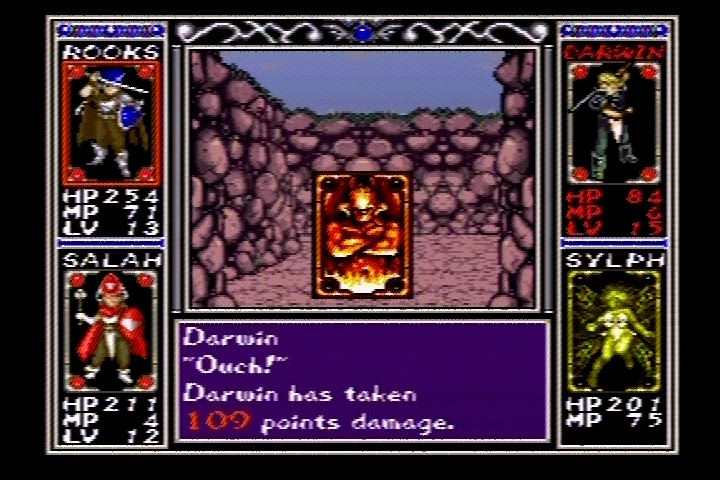
He also had some spells (heal and attributes) that didn't make him completely useless. Seen in the picture above is a critical hit on Darwin. Attacks can critically hit for double damage, but also have a chance to miss. Efrite here is actually the fire spirit, and after this battle he joined the party. Spirits don't tend to say much, so the party noted how odd it was for a spirit to attack people before moving on. I guess all the other wild beasts are normal. Darwin thanked me for the assistance in defeating Efrite, and departed. Through another small section of forest we came upon the home Reinoll the Elder.
 |
| I haven't mentioned the translation much, but it's not the best |
 |
| Aside from all the strange grammar, in the very next sentence Fanas became Fanal |
So, Reinoll, being the wise old hermit that he is, laid out the main objective. The evil empress could only be awakened with the three treasures: the crystal sword, spirit sword, and enchanted jewel. To seal her required the same three treasures in the possession of a card master capable of using all four spirits. Two down, two to go I guess. The enchanted jewel was in Salah's possession, and she hid it in the Ice Mine. She helpfully went off to go get it while Rooks and Reinoll continued to chat. Seriously?! Split up the party for no good reason? Well, thankfully Ariel was outside, and graciously volunteered to escort her to the Ice Mine.
 |
| Yeah... about that translation |
Outside I ran into Zerel, Ariel's first apprentice. This was the first boss that didn't have an element, but it wasn't difficult. At the conclusion of that battle, Rooks lamented losing Salah, and began Chapter 3. Back in town he searched for Axs, but only found a letter from him to Salah. It said, "I'm coming to the Ice Mine. Don't do anything until I get there." My only thought is how in the world Axes expected Salah to get this message. Somehow the shop had new equipment, and I suited up with a spiked shield that didn't actually seem to raise my attack as advertised, plate mail, and a scimitar. The manual incorrectly listed it is as a water attribute weapon.
 |
| Hooray for plot related spells |
I had a vague memory of where to find Axs. The start of this chapter is rough, and required heavy reliance on using 3 elemental cards nearly every battle. The game definitely has an unpolished feel that I never understood when I first played it. Petrification and paralysis are both listed as status effects, but I never found an enemy that used them nor the related healing items. Rooks learned the Unpetrify spell early on, and it's only used in this instance. Another oddity is a fourth slot in the equipment section of the Weapons and Ability menus for each character. I wonder if these were intended to be used, but didn't make the cut.
 |
| A sample of the auto-map, the Ice Mine is a maze of three levels with multiple staircases |
Axs is a mostly useless character. His single spell is a single target debuff, he uses inferior equipment, and to top it all off he was holding out on me. We ventured through the entire Ice Mine, culminating in a boss battle against a fire hydra, and then only after all that does he recognize Rooks as a full grown man capable of using the card spirits. "Oh yeah, have this water spirit now."
 |
| I guess he enjoyed the walloping we received |
I found Salah in a lava chamber, put to sleep by Ariel. He gloated once again, and offered us a spot at his side. This time I didn't get the option to choose, and faced off against another of his apprentices. This one was very similar to the first except easier now that I had three spirits. Marid, the water spirit, has a spell that heals the entire party for a small amount. Efrite also learned a singular heal spell recently, but I used up most his MP on the hydra. We ran off after Ariel, but had to stop at the next town to allow Salah to recover.
 |
| Enter random green lady at the beginning of Chapter 4 |
Icorina watched over Salah as Axs and Rooks went to scout out Stavery Tower. On the first floor we discovered the earth spirit after defeating someone named Darama (shortened to Darah in combat). On the second floor was a sealed door. With no way forward we were forced to return to town for Salah. She was feeling better, and only her (royal) tears would open the doors. I traveled light on equipment knowing that Axs and Salah would get their best inside the tower. As an example, invoking the Demon Axe casts earth elemental spell 3. Equipment can be invoked an unlimited number of time, but not all equipment has an ability to invoke (and most aren't worth it).
 |
| I don't even know what word they were going for here |
Dao, the earth spirit, left my party at some point, claiming I hadn't yet mastered him. Darama emerged once again, but this time with Barama. Once they were defeated, Dao permanently rejoined the party. Up and up we went through Stavery Tower until finally we came upon a door off to the side. In a scripted sequence, Salah commented on it, Axs cautioned the possibility of a trap, and Rooks boldly strode in. Ariel was waiting there, and we had a bit of chat. He mentioned Teefa was off getting the Spirit Sword. Salah proclaimed that was her sister, which wasn't really as much of a shock while playing the game. A 1-on-1* duel ensued.
 |
| *I have spirits and you don't |
Just as Ariel was spilling the beans on Galneon's plans, Galneon appeared and wiped out Ariel then proceeded to laugh in our face. He claimed to have killed Zahan (Rooks' father) with his own hands, a fact that I suppose motivates Rooks even more. We then ran out the door after him, ignoring Axs and Salah. Seriously, the game leaves us sitting there outside the door, alone. A couple floors up we ran into Darwin. At least we have another body.
 |
| One that can't equip anything Axs or Salah were using |
The company of Darwin didn't last long. We ran into Teefa on the way up, completely under the will of Galneon. After an easy battle, instead of joining us, Darwin left to watch after her. Rooks continued to climb Stavery Tower facing off against tougher and tougher battles solo. By the time I reached Galneon on the 12th floor, I had depleted my resources. Luckily, Axs and Salah joined the party as I entered. I suppose they only left to make room for the side story of Teefa and Darwin. Axs threw us out of the room as Galneon released his power to awaken Rimsala.
 |
| Begin Chapter 5 |
Rooks awoke to find Teefa and Darwin tending to him. Salah had gone to Icorina's place, and we suspected the worst for Axs. Darwin told us that he was Teefa's protector, but he lost track of her many years ago. The Reign of Evil (as it's worded in the dialogue) had begun, but it wasn't too late to thwart it. Bintel Castle was the name of both the town and dungeon. Most of the equipment was overpriced and unnecessary. The best equipment was found in the dungeon, and it far outclassed anything I could buy.
 |
| The first boss, Karul, dropped the Crystal Sword... you'd think they'd guard these better |
The castle is a fun little dungeon with side passages that have a particular elemental dragon in random combats. Later rooms follow the order of the elements, but switching spirits outside combat in each room was cumbersome, so I rarely did it. Behind the castle we found A Tunnel (this is the name). We ran into a crazed Galneon that resulted in two fights back to back. The first battle rewarded us with the jewel, and the second with the Spirit Sword.
 |
| Darwin with a bit of sass as he dodges Galneon's attack |
At the end of the tunnel we found ourselves at the back entrance to Stavery Tower. This led to an abbreviated climb up the 12 stories. Along the way we ran into a couple bosses. The first set was intercepted by Axs (still alive!) and Salah, and the party pushed forward. The second attacked from behind, and while I'm sure we could have taken down Tiamat easily, Darwin and Teefa forced Rooks to press on. Apparently we were in a rush to reach Rimsala before she awakened.
 |
| Wait, wait, wait... you need me to revive you... well I'm just going to leave now |
Rimsala was locked away in a shell of her former glory, and possibly trapped in this state. Hardly capable of putting a scratch on Rooks or the spirits, I chipped away at her. Something felt wrong about the whole thing. Was this really the great Evil Empress?
 |
| Ah, that's more like it |
Once she awoke, she attacked once and dropped Rooks. As he slipped into unconsciousness he heard the voice of Fanas encouraging him. The three treasures then combined into the Giant Sword. Somehow, with this sword automatically equipped, Rooks was now able to withstand Rimsala's attacks (somewhat). He came to fully restored, as well as his spirits.
 |
| How about some nightmare fuel? |
The battle with Rimsala takes a lot of luck to get through. She can either attack for 50 HP (30 fully buffed/debuffed), or she can cast Attribute 11. This spell hits both Rooks and the spirit for 130 - 170 HP. Rooks learns Heal 3, which fully heals a single target, and before this I'd say the fight is impossible. I went through all of Marid's and Efrite's healing, and all the spirits buffing before I deemed them worthless. At most they could do 27 HP, and Rooks' attack inflicts 170.
 |
| I tried to use the spell Ruinous Mission, but it had no effect... still not sure what the spell is supposed to do |
I was really worried at one point. The battle dragged on for quite a while, and I was often pinned down by multiple Attribute 11s in a row. The way turn order works is a bit strange, and Rimsala was often taking two actions in a row, sometimes three. So, I did my best to ensure my HP didn't drop below 300 before she could take one of these double actions. Eventually, with all spirits crushed, Rooks sealed away Rimsala.
 |
| Not exactly my last possible attack, but I had no more items and only three more full heals |
The screen faded save for Rimsala as lightning flashed about sealing her away in darkness once again. Ten more years passed, and the land was starting to heal from the dark influence. Hope had returned (ready to be crushed once more). Apparently, this was long enough that only Rooks and company recalled the troubling events. Peace returned.
Elapsed Time: 8
h42
m (
Final Time: 8
h42
m)
 |
| Everything except Galia is visible in this picture |
Combatant - Combat is incredibly easy if you know how to use it. The first two chapters are mostly a breeze, but some elemental cards are useful. This is really the only interesting strategy in combat as most battles don't generate enough gold to continuously spam them until the Ice Mine. Enemies are interesting and well animated, but seem randomly clumped together. Character stats don't make as much of a difference compared to equipment upgrades. With little challenge or variety, it's a rather generic experience.
Rating:
4
 |
| The credits show off some alternative art for the characters |
Admirer - Characters level up via experience, but grinding takes a while with very little difference in the long run. There's no customization, and attack animations don't reflect any of the equipment a character uses. It would have been nice to see the fist animation used when Darwin was weaponless in Stavery Tower. Controls feel sluggish, and moving in a dungeon is a slow process. I do like the variety in character portraits and animations.
Rating:
2
 |
| Great designs |
Puzzler - One thing you may have noticed is I didn't describe the dungeons very much. That's because they're devoid of anything resembling a puzzle. There are no side quests either. It's a straight shot from the beginning of a dungeon to the boss with some scattered chests and A LOT of combat.
Rating:
1
 |
| Good job Pantsman |
Instigator - The story while not great does it's job by motivating the player to continue playing. There's no intrigue worth playing out, and the world tends to lack description. Most equipment and spells do have a little something. I never really felt this was a believable place. It lacked some common sense, like allowing Salah to run off on her own after the harrowing dungeon crawl we just had. Decisions seem to make no difference to the plot, although I still wonder what refusing Darwin would look like.
Rating:
2
 |
| Maybe it was all just lost in translation |
Collector - There's a bare minimum variety of items, but the honey pots are enough incentive to seek out every chest. The economy never became irrelevant as equipment is expensive, cards are a constant sink, and buying honey is eventually an option. Inventory is limited, but I only ever hit the card limit. The strength of equipment isn't always obvious, and there's no way to really know if you've collected everything. There's not much use in doing so though. The only equipment that can be invoked are those already equipped in battle.
Rating:
5
 |
| These names are familiar |
Explorer - This would have been higher if it was possible to actually explore the world. The music is fantastic, but the environment graphics are rather drab in the dungeons. The towns are navigated by switching to fixed points for each building. There's a lot of chests to find, but nothing else of interest. The music really sets the atmosphere for the whole game, but I wish it was more rewarding to search the whole map. The chapter based divisions cut off past areas, and make it impossible to skip any location.
Rating:
4
 |
| The man behind the music |
Final Rating:
18 [30%]
Overall an enjoyable experience, and I'm glad I got to play it again. Other reviews of the game compare it unfairly to Dungeon Master. Aside from the first person perspective, I really don't understand the comparison. Combat is turn based, characters have set classes, and the enemies aren't visible until combat randomly occurs. It has more in common with Wizardry where instead of one large dungeon, we get different towns with smaller locations that grow in size with each chapter as well as a fixed cast of characters. Given that comparison it's an easier version, if not a step up for the turn based dungeon crawler. HAL never again bothered to localize another RPG, and instead focused on their Kirby franchise. It seems they had a hand in Earthbound, although it's not clear what role they served. The also had an action-RPG called Alcahest, heavy on the action.
 |
| 10/10 would seal away again |
Apologies for the late post; I managed to injure my hand last Saturday, and it's taken a week to heal enough for me to type again. I haven't fallen behind though as I haven't been able to play either. Next up is Order of the Griffon, which I know very little about. TurboGfrax-16 is a system I never owned until a couple years ago, and I've been eager to get to this. It either has some involvement from SSI (seems to have a gold box style engine) or just licensed the rights to create an AD&D video game. Westwood Associates was also involved, the creators of Warriors of the Eternal Sun. I'm not sure if the same group of people worked on both, but the same company gives me hope.