To start, now that I've finally come to the end, I'll weigh the RPG factors a final time, and then give my final review:
Phantasy Star (SMS) - Rating(15 RPP)
1) 4 - Character advancement: practice/experience based advancement, stat or level increases, multiple classes or characters,
customize characters
2) 4 - Combat: character stats used for combat, additional combat options, turn based
3) 2 - Items and equipment: store to buy and sell,
equipment decisions,
item decisions
4) 2 - Story: main story at the forefront; world full of lore;
descriptions for objects, people, and places
5) 2 - Exploration: open world, visited locations remain open
6) 1 - Quests and Puzzles: side quests not related to the main quest,
puzzles and riddles to solve
It's interesting to note that the game lost some points from my initial estimate. I guess after getting a thorough understanding, it's now obvious that there aren't any equipment or item decision. Everything is pretty obviously better, and equally viable options don't exist.
 |
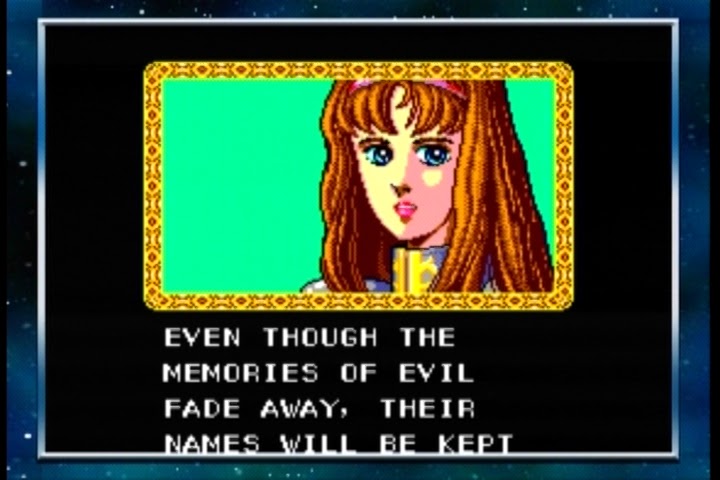
| What did the heroes do? I don't know, but they were great weren't they? |
So, on to my first use of the full rating system. I try to give a complete understanding with many examples. That's why I think it's fitting to ask,
CAPICE?
Combatant
Like most RPGs there's a good amount of fighting in this game, and like most the fighting gets repetitive. There are spells and some items that break up mashing attack, but with magic points so scarce (and no way to recover them in the field) I often found myself saving them for boss fights. They are interesting to watch with colorful graphics and animations for each monster. Don't get too excited though, these animations usually consist of a single arm moved in a slashing motion while the rest of the sprite is still. For the time, this was very impressive, as its peers maintained static images for some time.
However, some animations draw out way too long (looking at you flying eyes and zombies), and some sounds were equally annoying (again flying eyes, and my own laser gun top this chart). Consistency is lacking: one fight has monsters with 180 HP and the next will have some with 30, and damage ranges from 1 - 60; it's hard to judge how well I was doing or if I was able to take on a boss. In the end the only real challenges are the length of the dungeons and the final bosses, as well as the beginning of the game where a single bad encounter with an Owl Bear can lead to a 1-hit dead, game over scenario.
Rating:
5
 |
| It's done, you failed! Back to the title screen with you! Game over screens were harsh back then. |
Admirer
Some of the most detailed graphics are shown in cut-scenes introducing each character. These are memorable, and give a good impression of what your guys look like. It's a guess most often what someone can use. I've already mentioned the Glove on Myau, but how am I supposed to guess that the Laser Shield is equippable by Noah when every other shield is not? Also hidden are spell costs, but it doesn't change, so I created my own list (if I only I remembered to refer to it more often). Maneuvering the party is very smooth looking, especially the dungeons with. Each step transitions seamlessly into the next.
Unfortunately, there's no way to visually customize the characters, and they aren't seen in battle. Leveling up comes only from battle experience, and the benefits taper off at about level 20; I started to get only 1 or 2 HP for each level instead of 10 - 15. This seemed worse than just capping the level at 20, and with 10 levels of no spells and minimal stats, it seemed these last levels helped the enemies more as their stats increase as the party levels.
Rating:
4
 |
| This is the only time you get to fully see your characters. |
Puzzler
All quests have one solution, which is unfortunate, as this is a missed opportunity for another first in the genre (at least on consoles). For instance, normally you can talk to dragons, but all chatting or telepathy seem to provide are small hints and a way out of battle. Why not have the Casba Dragon depart and leave the gem behind after talking to him? There's not a lot offered here beyond combat solutions. Some items are discovered by searching, but only after you've learned about them. A treasure chest containing the Dungeon Key doesn't appear until the appropriate plot flag is triggered. Other solutions are talking to someone three times, or using an item.
There are hints, and they're easy to follow, so I never felt lost for what to do (although I did find myself unable to find where things were a couple of times). How everything fits together isn't well explained though, and the flow from one thing to the next is often obscure or downright confusing. (The only cake shop in two worlds is at the bottom of a dungeon... really?) There are optional quests to take on, but without knowing what the main quest requires it's difficult to know the difference.
Rating:
2
 |
| Guess which house has the right pile of junk to find Hapsby... |
|
Instigator
Alis watches her brother die, swears revenge on Lassic, and then spends the rest of the game hoping to stumble over him. The story quickly loses steam and cohesion after getting the spaceship. At this point there's no clear direction to take, and all mention of Lassic disappears in the next few towns. Nothing changes in the story, and NPCs continue to give the same hints no matter how many times I spoke to them.
There is some background, but mostly it's related to completing the game and little to do with enriching the world. We learn nothing more about Lassic either, and only at the very end do we get a hint of background for Alis. Noah gets one side quest from his thus far unknown master, Myau gets to transform for a short while (not really explained), but Odin has no further interaction in the story (even after confronting and killing Medusa).
The story boils down to saving the world from an all powerful evil with no other concerns. I suppose I'd be remiss if I didn't mention the female heroine, which was rare for the time (or now even), but honestly, I don't see what would change if Alis were a man. (A side note: if Alis is killed during the last battle, but you still win, she will be resurrected by her brother's spirit for the epilogue. 1 point for keeping continuity.)
Rating:
4
 |
| Sadly, the Alsulin used to save Odin causes him to lose his ability to speak after this |
Collector
Probably the least fulfilling aspect, the number of items are very limited and inconsistent in power level. A large gap exists between the best and second best, with some equipment available so quickly that the previous ones are obsoleted at the next town. Searching for treasure is an exercise in futility as many of the chests are empty with traps, or contain such a pittance that winning 1 fight gives more reward. (What is the use in finding starting equipment in the final dungeon?) With a limited inventory there's no way to have everything at once. A hovercraft takes up as much room as a burger. There's no way to unequip things. Only two healing items exist and inventory management becomes a pain when enemies start throwing flashers around like they're going out of style. In fact they did when I got a magic lamp. I was never hurting for money. I had just about enough to purchase most things as I came across or needed them.
There's no way to know if you've done everything. With secret doors, the completely obsessive can spend hours searching every wall of every dungeon. Another hidden feature is the wand; it is the only piece of equipment that has a use in combat (it'll act as an escaper: a 100% chance to run unless physically impossible). No hints, and no other equipment have an ability. Aside from blindly trying to use items in battle it's unlikely I would ever run across this. However, now that I know, I'm definitely going to make sure I try using equipment in combat in future games. I remember some Final Fantasy games had this as well.
Rating:
3
 |
| Why can't I leave Hapsby on the ship? |
Explorer
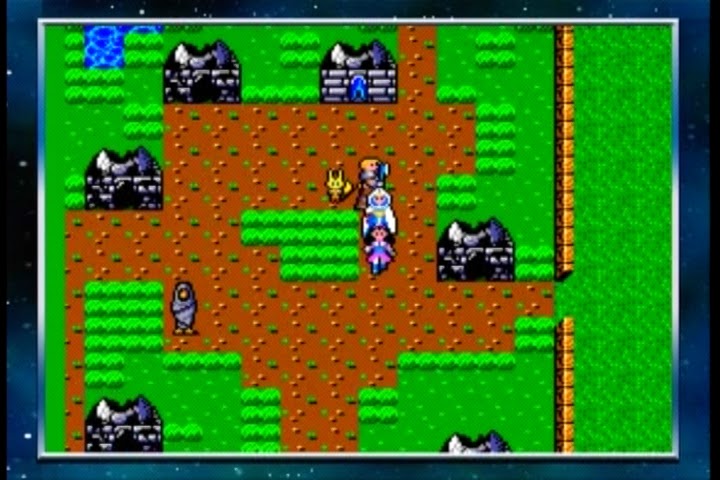
The best part of the game is the graphics, animation, cut-scenes, and smooth dungeon crawling. Exploring dungeons are a bit of a slog with the identical corridors; helpfully most dungeons have a different color. The planets themselves are unique and easily identifiable. Motavia (the desert planet) has ant lion pits, Dezoris (the ice planet) has... well ice, and Palma (Alis' home planet) has grass, forests, and an ocean. Yet, the size of these planets seem very small with the maps wrapping around quickly. Honestly, they could just as well have been 2 continents and an island cluster without much loss in continuity. I can only imagine multiple planets were used to fit the futuristic motif, but it led to illogical aspects like spaceships that can't reach a floating cloud fortress.
The sounds and music are rough. Boss music isn't menacing, some sound effects are grating, and nearly everything else is forgettable (the title music is the only memorable track). It's obvious that Star Wars had an influence, from guards in the guise of Storm Troopers to farmers in the desert that look like Jawas (not to mention light sabers). There's a mention of Sega Games that I found amusing at first, but its only purpose seemed to remind me that I'm playing a game, and the NPC actually questioned me as to "why did I play this far..."
Rating:
6
 |
| If I could control the space flight, maybe it'd feel like I was playing on different worlds. |
Final Rating:
24 (
40%)
Overall, I'm happy with this rating, and it does well to reflect my enjoyment of the game. Playing it now the game feels average, but I recognize a lot of historical significance. I'd really only recommend it for those interested in discovering the roots of Phantasy Star or CRPGs in general; for others, find a recap and move on to save yourself 20 hours. I know there are better games out there. I think it's less interesting to see a score for a single game, so onward and forward, and let's get some more up for comparison.
Next up is Zelda II: The Adventure of Link. A controversial series when considering what games are RPGs, this one should prove as close as possible though, and give me a nice break before getting into another heavy game with Ultima: Exodus coming up. I'm taking the night off for Valentine's day, but we'll pick this up on Thursday. I'll make the intro post tomorrow.
Lastly, as an aside, I participate in a speedrunning community; we take it upon ourselves to time-attack all types of games, even ones without timers. Phantasy Star happens to have a run completed many years ago. While it took me a good 20+ hours to get through on my first try, someone named Brightstar was able to beat the game (after much practice and planning) in just
5 hours and 40 minutes (
direct link to video). That being the GBA version, walking is slower in dungeons, so the same luck and strategies would mean a much lower time. It amazes me that a game this long boils down to a quarter of the time when going straight for the goal.